 Search
 Menu
Menu
I’ve always had a real buzz of energy getting off the train at Manchester Piccadilly - a feeling of a City Region with confidence, a strong sense of self, and hope for the future.
Posts abound about what this Manchesterism is and isn’t and how it might apply to everything from foreign policy to taxation.
At Innovation Unit we have had the great privilege of working in partnership with the Greater Manchester Combined Authority for close to a decade - including at the heart of Andy Burnham’s signature public service reform programme Live Well, which embeds every day support for every resident in every neighbourhood.
Now the Prime Minister wants to take this approach to the nation:
"We will help people to live well, building a more preventative state, investing in people’s success, rather than paying for failure."Andy Burnham
What’s it going to take?
I believe there are 3 pieces of the Live Well puzzle that are highly transferable - and totally necessary - to make the preventative state a reality in every neighbourhood across the whole of the UK:
-
Invest in enabling people to do their jobs differently
-
Bang the drum for growing what already exists - don’t start from scratch
-
Turn policy-making on its head
1. Invest in enabling people to do their jobs differently
Flagship national public service reforms tend to focus on structural change: new service models, new geographies to work across, revised targets. Neighbourhood health (rightly!) envisages a revolution in people accessing support in the community and has lots to say about which services should work together on what patch. Structures are unquestionably important - and there’s something missing.
Reforms tend to be silent on how the people in those structures understand and therefore do their jobs. That’s why the reality of public services so often stays stuck, despite the flurry of policy announcements.
Public services are about people: the GP, social worker, teacher and health visitor; the commissioner, Local Authority Chief Executive and local politicians.
Live Well in Manchester recognises that the list of people key to the preventative state doesn’t end there: the brilliant local voluntary sector organisations; community leaders and members; local businesses and, of course, every single resident of Greater Manchester themselves.
Our work (and that of many others) has been about unlocking the capacity of people to see and do their jobs differently - to work together in new ways - to make every day support in every neighbourhood a reality.
Almost always, this is about helping public servants to reconnect with the purpose that brought them into public service in the first place - and liberate them to work in ways that they know will have greater impact.
In our partnership with GMCA we have co-designed and run 4 cohorts of a ‘Leadership Collaborative’. The Collaborative works with leaders at every level to help them work across sectors, and in partnership with communities to unlock the full capacity of a place to support every one of its residents. This is a shift that’s easy to underestimate - for many years, people in public service have been required to focus on narrow organisational targets and to restrict access to their service.
The Leadership Collaborative unlocks the belief and agency of leaders to break out of habits and behaviours they have been taught through their public service careers - alongside growing the capability to work in new ways.
Investing seriously, nationwide, in supporting this long list of people to unlearn and relearn their jobs - to unlock a different model of public services - must be a non-negotiable, national priority if the buzz of Live Well is to become a reality across the country.
2. Bang the drum for growing what already exists - don’t start from scratch
For the Chief Exec of an Innovation Unit to say ‘stop with the new stuff’ is odd.
Except that as Manchester colleagues have told and repeatedly showed us over the years, there are countless examples of brilliant, community-led, preventative, equitable new models of public services across Greater Manchester and across the country.
The real challenge remains how to make these beautiful exceptions the norm.
In Greater Manchester, Live Well has understood that and been about liberating and unlocking the full potential of the great work that’s already there - whether it’s Rochdale’s Anti-Poverty Foundation Group, or Salford’s CommUNITY Little Hulton. Live Well has turned their work from being a daily fight against the prevailing system of public services - into a GM-wide shared endeavour for the future.
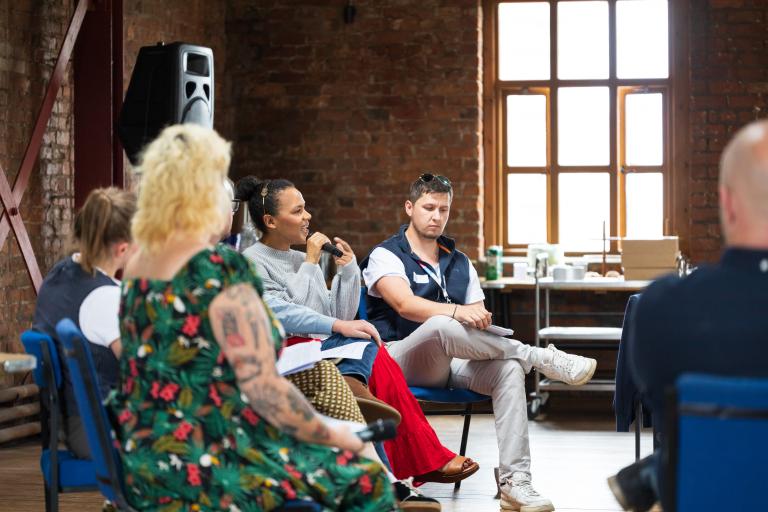
Big, cross-sector events and bus tours have created a strong sense of shared purpose, with Andy’s endorsement at the heart. Innovators from the voluntary sector to the health system who have long felt like rebels, knocking on the door with their stories and evidence of impact, have begun to feel like important contributors to a shared Live Well mission.
Importantly, alongside this new narrative, targeted programmes have begun to model what it looks like to unlock the best of GM’s practice at scale. The Live Well trailblazer programme, funded by NLCF and supported by Innovation Unit shows some of what that looks like in practice - with new voices in decision-making, money in the hands of communities and new local priorities driving activity.
At Innovation Unit, we have learnt over 2 decades that spreading powerful, community-led, preventative models needs a mix of:
- strong common purpose and movement building that connects and empowers innovators;
- intentional growth of new practice through training and communities of practice;
- investment in codifying successful models and supporting new places to adapt them to their context;
- and, of course, shifts in the policy landscape to support these new ways of working, rather than getting in their way.
The new Prime Minister could not be better placed to replicate this common purpose and movement nationally. He has already begun. And if he’s going to be successful, he’ll need to avoid a binary ‘spread or scale’ debate. We need all of it to liberate and unlock the brilliant work that’s already scattered around the country. We have to focus on the ‘grow’ in ‘test, learn and grow’. No more pilots please.
3. Turn policy-making on its head
At the moment, even the best work to build community-led, preventative, equitable public services gets stuck at some point.
It gets stuck when cross-sector, multi-disciplinary teams come up against narrow targets, risk management protocols or data-sharing agreements designed around single organisations rather than places or people. It gets stuck when the big money continues to flow to managing crisis, rather than being diverted into prevention. The list is long.
For the most part, our current approach to national policy-making guarantees that these tensions will continue. Policies, priorities, accountability, risk management designed in separate Whitehall departments and flowing down to local places with no say in the matter.
GM is in the foothills of a different approach. What if national policy followed and sought to unleash Live Well style public services, rather than getting in the way?
The Prevention Demonstrator, working hand in hand with Live Well, seeks to test and prove from the ground up what a different relationship between local, regional and national government could look like. This is a critically important experiment.
If Live Well is to become a national reality, we need much more of this kind of experimentation - senior civil servants, across departments, working in partnership with our best innovators on the ground to understand what needs to shift and how - in everything from what we measure to where the money goes and how we assure the public of its value.
In the Autumn, we will be running a ‘sprint’ in GM to help unlock a Live Well journey to employment at scale - local innovators, regional and national policy-makers defining the key changes they can make together to make work like Manchester’s employment support for people with musculoskeletal conditions the reality throughout GM, and ultimately the UK.
The collaborative aspect of this is key - we can only solve these policy challenges by understanding each other’s perspectives and working through the issues together, locally, regionally and nationally.
The experimental aspect is just as important - we need to de-risk policy-making. The big bang ‘announceables’ model of policy-making (as the excellent James Plunkett puts it) creates unbearable pressure on those at the centre to get it right first time under a glaring spotlight.
I’m hoping the new Prime Minister will flip this on its head - with permission and investment into a host of policy-making experiments up and down the country. This approach has the potential to build a quite different model of government, unleash the preventative state at scale and help bring his devolution ambitions to life.
So much of the focus on this new administration will be about whether and how they can take the successes of Manchester (and elsewhere) and make them a reality in ‘every post code’.
The bold investments that the Prime Minister has made in Live Well Greater Manchester in people, practice, movement building - and policy-making that enables community-led innovation rather than getting in its way - are the right foundations for bringing the preventative state to life across the UK.
Share this page
 Share this on Bluesky
 Share this on LinkedIn